
What is a Shark: Fish or Foe? by Ethan Prawdzik

Introduction
Imagine you are at the beach when you hear someone yell, “Shark!” What is your initial reaction, and what image first pops into your head? You might be imagining a large-bodied apex predator like a white shark or a tiger shark. The first thoughts to race through your head might be big, scary teeth and a large dorsal fin sticking out of the water with the Jaws theme song playing in the background. I challenge you to think about what else a shark could be, and what other images might come to mind. It could be a slow-moving carpet shark, like a nurse shark or a wobbegong, languidly cruising by. It might be a species of angel shark submerged in the sand, resembling a stingray more than a shark. Maybe it's a lantern shark the size of your palm, glowing faintly like a starry night sky. If you are lucky enough, it could even be a whale shark taking their fill of a fresh patch of krill.
So, what is a shark? Well, sharks are fish that fall into a specific class called Chondrichthyes7,17,32. They are characterized by skeletons made from cartilage, the same stuff that your ears are made of32. The class Chondrichthyes is a sister class to the bony fish, which are known as Osteichthyes (Figure 1). They are further differentiated from bony fish by their exposed gills, lack of swim bladders and placoid scales (rough tooth-like scales)7,17,32. The Chondrichthyes class contains sharks, rays, and chimaeras. Sharks and rays are further subdivided into the subclass Elasmobranchii, where sharks are separated from rays based on their physical characteristics. Sharks are differentiated from rays by their fusiform body shape, pectoral fins not fused to the head, conspicuous dorsal fins and gill placement on the side of the body.
 |
Figure 1. Phylogenetic tree showing sharks’ relationship to other fish clades. |
So, then, how do you define a shark? Because of their great diversity of shape and size, it can be difficult to form an exact definition, but they can be generally defined as follows: A shark is a cartilaginous fish with a conspicuous dorsal fin, 5-7 gill slits, placoid scales and a fusiform body32. The cartilagenous skeleton of sharks is an adaptation to remain lighter, swim faster and maintain more flexible bodies. Sharks have remarkably strong olfaction, vision, hearing, and, like all other fish, the ability to detect pressure changes using their lateral line. A unique trait of sharks and other elasmobranchs is their electroreception capabilities14. Using specialized organs called ampullae of Lorenzini concentrated on their snouts, they can detect minute changes in electrical signals from the environment (Figure 2). This adaptation is key to their adept prey-finding ability. Another trait unique to sharks is their multiple rows of overlapping teeth that are constantly growing in a conveyor-like fashion, replacing the front teeth when they fall out (Figure 3)2,6. Unfortunately, due to sharks' slower growth rates, low reproduction and sensitivity to fishing pressures, many species are endangered or critically endangered (Figure 4). The 2024 report from the International Union for Conservation of Nature (IUCN) indicated that a third of sharks, rays and chimaeras are now threatened with extinction13.
 |
Figure 2. Focal view of the ampullae of Lorenzini on a Lemon Shark (Negaprion brevirostris). |
 |
Figure 3. Jaw structure of a nurse shark showing the overlapping tooth system. |
 |
Figure 4. Graphs showing global shark decline since 1980 using the IUCN’s Red List status as a measurement. |
Sharks form a very diverse group with over 500 described species occupying all marine environments from shallow tidal waters to the deepest ocean basins4,5,29. They frequent coastal waters, estuaries, the high seas, and some species even utilize coastal rivers4,5. They exhibit vastly different physical forms and sizes, from the smallest dwarf lantershark (20 cm) to the largest whale shark (17 to 21 m). The diversity of sharks is due in large part to their use of different niches and their evolutionary age34. Around 450 to 400 million years ago (MYA), we see the first fossil evidence of sharks' relatives, the Acanthodians (Figure 5)8,17,28. While these cartilagenous fish did not physically resemble today's sharks, they did share many traits and began the evolutionary journey to what we now consider sharks. If we continue to about 380 MYA, a genus of cartilagenous fish called Cladoselache enters the scene (Figure 6)8,17,28. This is the first group that we would recognize as sharks today. Further along during the Carboniferous period (359 MYA), we see a great increase in sharks during what is known as the “golden age of sharks”8,17,28. It is then, during the early Triassic (195 MYA), that the oldest lineage of modern sharks evolves. These Hexanchiformes are still extant today and form the base of our current modern shark lineages15,29. From here, sharks continued to evolve and diversify to form the living species we now have today.
 |
Figure 5. Representative images of an Acanthodian from the fossil record. |
 |
Figure 6. Representative image of a fossil specimen from the Cladoselache genus. |
Shark Orders
Sharks are currently separated into nine different orders: Carcharhiniformes, Lamniformes, Orectolobiformes, Hexanchiformes, Squatiniformes, Heterodontiformes, Pristiophoriformes, Squaliformes, and Echinorhiniformes15,34. These orders are primarily distinguished from each other by physical characteristics such as body shape, fins, number of gill slits, and tooth variation. The order Echinorhiniformes used to be grouped with the Squaliformes, but has recently been placed in its own separate order based on physical characteristics15.
 |
Figure 7. Key showing the different shark orders, representative species and traits that differentiate them. The Echinohiniformes are missing from this diagram, as they were only separated recently. |
The Carcharhiniformes are the largest order of sharks with over 250 different species4,5. This group is often called the Ground sharks, and many of its species are what you would typically think of when you hear the word shark. General features of this order include five gill slits, a nictitating membrane (transparent protective eyelid used when feeding), two conspicuous dorsal fins and a large mouth that extends beyond the eye. Representative species from this group include the tiger shark, great hammerhead, lemon shark, bull shark and reef shark.
 |
Figure 8. Representative species of the order Carcharhiniformes. Top Row right to left: Tiger Shark, Great Hammerhead Shark Bottom Row right to left: Lemon Shark, Caribbean Reef Shark |
The Lamniformes are a much smaller order compared to the Carcharhiniformes, with only 20 species, but they also exhibit a typical shark profile with many highly recognizable species34. This group is often called the Mackerel sharks and is characterized by five gill slits, two conspicuous dorsal fins, a special lamnoid dentition pattern and some sharks having limited endothermic ability31. Mackerel sharks tend to have much more pointed noses and be more torpedo-shaped anteriorally than the Ground sharks. Some sharks in this group include the white shark, mako shark, thresher shark and basking shark.
 |
Figure 9. Representative species of the order Lamniformes. |
Orectolobiformes make up an order of approximately 40 species that have very diverse body shapes and colourations15. They are commonly called the Carpet sharks for their diverse carpet-like skin patterning. This group is characterized by five gill slits, two dorsal fins, spiracles near the eyes, barbells and patterned skin. Their spiracles are external openings that they use to pump water over their gills while at rest. This group generally consists of slow-moving bottom-dwelling sharks, but there are exceptions. Some representative species include the nurse shark, wobbegong shark, zebra shark and whale shark.
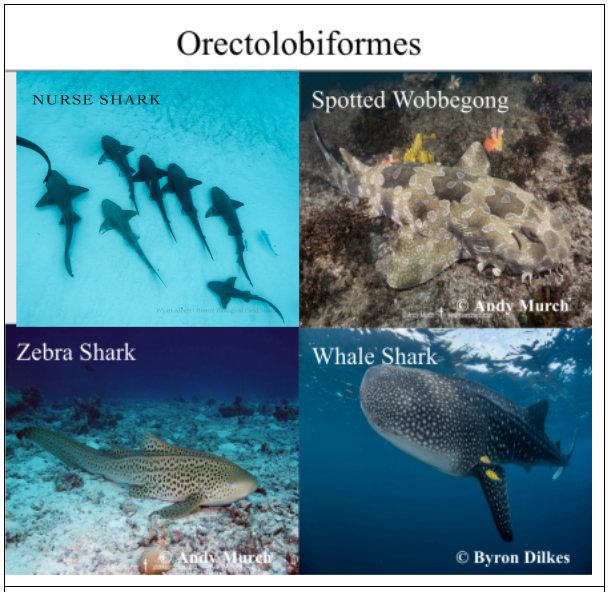 |
Figure 10. Representative species of the order Orectolobiformes. |
The Hexanchiformes are the most primitive order of the extant shark orders. There are currently six to seven described species that make up this group, collectively called the Frilled and Cow sharks15,18,. They are characterized by having six or seven gill slits, a single dorsal fin, thorny teeth and most species inhabit deep water. The bluntnose sixgill shark, frilled shark, Atlantic sixgill shark and broadnose sevengill shark are all members of this order.
 |
Figure 11. Representative species of the order Hexanchiformes. |
There are approximately 24 species in the order Squatiniformes, all of which are different species of Angel shark1,3,15,35. Sharks in this order all have flattened bodies, nasal barbels, no anal fin, spiracles on the top of the head and topward-facing eyes. The Angel sharks are physically quite similar to rays, but a few specific features differentiate them. Angel sharks possess two dorsal fins, gill slits located on the side of the head rather than underneath, and pectoral fins not fused to their heads. Species of Angel shark include the Pacific angel shark, Atlantic angel shark, Japanese angel shark and common angel shark.
 |
Figure 12. Representative species of the order Squatiniformes. |
Heterodontiformes consist of both the Horn sharks and the Bullhead sharks, comprising approximately nine to ten different species2,11. They can be distinguished by five gill slits, spines on their dorsal fins, and heterodont teeth. Their heterodont teeth, for which this order is named, are sharp conical-shaped front teeth used for grasping prey and rear molariform teeth used for crushing prey. Sharks in this order include the Port Jackson shark, Japanese bullhead shark, zebra bullhead shark and Mexican hornshark.
 |
Figure 13. Representative species of the order Heterodontiformes. |
The Pristiophoriformes currently have eight to nine accepted species, known as the Sawsharks15,27. The Sawsharks are dorsoventrally flattened, have five or six gill slits, two dorsal fins, no anal fin, barbels and long saw-like snouts. Sawsharks can be differentiated from sawfish and other ray species by their side-facing gill slits and prominent barbels. Representative species in this order include the longnose sawshark and the Japanese sawshark.
 |
Figure 14. Representative species of the order Pristiophoriformes. |
Squaliformes are a very diverse order of sharks containing approximately 115 to 125 species15,24,33. Some groups in this order are the Dogfish, Sleeper sharks and Lantern sharks. They have long snouts, short mouths, five gill slits, two dorsal fins, no anal fins, and most are cold deep-water sharks. Notable species in this order include the Greenland shark, Cuban dogfish, dwarf lanternshark and cookiecutter shark.
 |
Figure 15. Representative species of the order Squaliformes. |
The Echinohiniformes were until recently considered a part of the Sqauliformes, but have since been separated based on physical characteristics15. There are two species within the Echinohiniformes that are distinguished from the Squaliformes by their broad flat heads, spineless dorsal fins and large thorn-like denticles spread across their bodies. These are the bramble shark and the prickly shark.
 |
Figure 16. Representative species of the order Echinohiniformes. |
Bimini boasts quite a high diversity of shark species, particularly in the order Carcharhiniformes (Ground sharks). Lemon sharks, great hammerheads, tiger sharks, bull sharks, blacktip sharks, Caribbean reef sharks, and blacknose sharks are all frequent visitors of the order Carcharhiniformes30. Nurse sharks, which belong to the Orectolobiformes (Carpet sharks), are abundant denizens of Bimini as well. Sharks of the order Lamniformes (Mackerel sharks) are less frequently spotted here, but species such as the mako shark and thresher shark do inhabit the pelagic offshore waters around Bimini. Though rarely seen, deep-water sharks such as the bigeye sixgill (Hexanchiformes) and Cuban dogfish (Squaliformes) are residents of Bimini’s depths.
Unique Species
Many lesser known sharks species are often overlooked because they inhabit deep or rarely visited habitats. Some remain relatively elusive due to their infrequent sightings and the difficulty in studying them. Others have appearances and behaviours that you would not typically expect of a shark, and are therefore frequently disregarded. In the next few paragraphs, I hope to introduce you to a few lesser-known shark species that are all unique in their own ways.
The smallest of all the known shark species is the dwarf lanternshark, which belongs to the order Squaliformes. These sharks grow to a maximum of 20 cm and inhabit deep-sea areas up to 400 m in depth33. They use bioluminescent photophores that line their ventral and lateral body surface to attract planktonic prey in the dark waters of the mesopelagic zone33. Another small lanternshark species known as the viper dogfish grows up to 54 cm and inhabits even deeper waters of 1000 m. They also use bioluminescence to attract their choice prey of small fish. Their name is given for the large, hooked, viper-like teeth that they use to capture their prey whole36. The Greenland shark is also in the order Squaliformes, but in contrast to the lanternsharks, it grows up to 7.3 m in length. They are slow-moving, deep-water sharks that are thought to be the longest-living vertebrates, with age estimates between 272 and 512 years old12,24.
Species within the order Lamniformes are generally very stereotypical sharks; however, the megamouth shark is certainly not what you would typically think of when you hear “shark”. They are filter feeders growing up to 5.5 m in length and are thought to be a deep-water species inhabiting depths of 40 to 150 m. Physically, they look unique with an unmistakable large round head, blunt snout and a large mouth that extends well beyond the eye16. These sharks are also incredibly rare to see, with fewer than 300 confirmed sightings since their initial discovery in 1976.
The frilled shark is a deep-water shark within the order Hexanchiformes that exhibits a very unique phenotype. They are elongated and eel-like, with a single small dorsal fin quite far back on their body and six gill slits. Their three-cusped teeth are specially adapted for catching their preferred prey of deep-water squid9. Frilled sharks have been known to live anywhere between 50 and 1500 m in depth.
Another rather strange species is the epaulette shark within the order Orectolobiformes. This slender carpet shark is identified by its large black spot ringed with white just behind its pectoral fin. They are typically found in shallow coastal habitats around reefs and tidal areas, where they feed on small worms and crustaceans23. An interesting adaptation is their paddle-shaped pectoral fins, which they use to crawl over shallow reef flats and tidal areas. They are adapted to withstand low oxygen levels, allowing them to spend extended periods of time out of water and essentially walk on land23.
Conclusion
Sharks come in all shapes and sizes, exhibiting a large diversity in body form. From the filter-feeding whale shark growing between 17 and 21 m to the smallest dwarf lanternshark reaching 20 cm. You have vastly different shapes between your typical shark-looking Carcharhiniformes and Lamniformes compared to the Carpet sharks, Angel sharks and Sawsharks. Diets differ greatly, with your largest sharks being filter feeders of small plankton and krill, like the whale shark, basking shark and megamouth shark. Other large species, such as the white shark, feed on marine mammals and even other sharks. Then you have your smaller Carpet sharks and Dogfish species that consume small worms and crustaceans. Sharks exist in all the world's oceans, from the warm tropical waters to the cold temperate and even the coldest Arctic and Antarctic waters. A southern sleeper shark was just recently documented in Antarctic waters as cold as 1.27 °C22. Sharks inhabit the open ocean, coastal waters, shallow tidal pools, the deep ocean and even freshwater, such as the Ganges shark.
The deepest discovered species is the Portuguese shark at a recorded depth of 3675 m20. Sharks have a large diversity in their respective food web positions, with some being apex predators and others sitting near the bottom, subsisting on small invertebrates. Others still have no predators and only consume small plankton. Then, of course, you have your species that exist somewhere in the middle, being both predator and prey to other fish and shark species. This vast diversity in size, shape, habitat, location and diet plays a pivotal role in forming healthy ecosystems and linking all the different trophic levels together. Every shark is important for the unique roles and positions they play in their ecosystems, whether big or small.
Citations
1Angel shark Squatina squatina — Shark Research Institute. (n.d.). Shark Research Institute. https://www.sharks.org/angel-shark-squatina-squatina
2Berkovitz, B., & Shellis, P. (2023). The Teeth of Non-Mammalian Vertebrates (2nd ed.). Academic Press. https://doi.org/10.1016/B978-0-323-91789-6.00008-X
3Between shark and ray: The evolutionary advantage of the sea angels. (2020, August 20). ScienceDaily. https://www.sciencedaily.com/releases/2020/08/200804111528.htm
4CARCHARHINIFORMES. (n.d.). https://fishesofaustralia.net.au/home/order/10
5Creatures, R. S. (2025, December 10). Requiem shark. Red Sea Creatures.
6Cunny, G., Guinot, G., & Enault, S. (2017). Evolution of Dental Tissues and Paleobiology in Selachians. https://doi.org/10.1016/B978-1-78548-139-0.50005-5
7Do sharks have bones? | Natural History Museum. (n.d.).
8Fossil focus: Acanthodians – PALAEONTOLOGY[online]. (n.d.).
9Frilled shark - Chlamydoselachus anguineus — Shark Research Institute. (n.d.-a). Shark Research Institute. https://www.sharks.org/frilled-shark-chlamydoselachus-anguineus
10Ganges Shark. (n.d.). WWF India.
11Horn Shark. (n.d.). Discover Fishes.
12How long do Greenland sharks live? (n.d.). https://oceanservice.noaa.gov/facts/greenland-shark.html
13Jabado, R. W., Morata, A. D. A., Bennett, R. H., Finucci, B., Ellis, J. R., Fowler, S. L., Grant, M. I., Martins, A. P. B., & Sinclair, S. L. (2024). The global status of sharks, rays, and chimaeras. IUCN. https://doi.org/10.59216/ssg.gsrsrc.2024
14Kajiura, S. M., & Holland, K. N. (2002). Electroreception in juvenile scalloped hammerhead and sandbar sharks. The Journal of Experimental Biology, 205, 3609–3621.
15Meet the nine types of sharks in the ocean | Natural History Museum. (2025, April 17). https://www.nhm.ac.uk/discover/nine-types-of-sharks-in-the-ocean.html
16Megamouth shark - Megachasma pelagios — Shark Research Institute. (n.d.). Shark Research Institute. https://www.sharks.org/megamouth-shark-megachasma-pelagios
17New Study Confirms Sharks’ Ancient Ancestors. (2017, March 16). American Museum of Natural History. Retrieved May 2, 2026, from https://www.amnh.org/explore/news-blogs/shark-ancient-lineage
18Pacific sleeper shark - Somniosus pacificus — Shark Research Institute. (n.d.). Shark Research Institute. https://www.sharks.org/pacific-sleeper-shark-somniosus-pacificus
19Pacoureau, N., Rigby, C. L., Kyne, P. M., Sherley, R. B., Winker, H., Carlson, J. K., Fordham, S. V., Barreto, R., Fernando, D., Francis, M. P., Jabado, R. W., Herman, K. B., Liu, K., Marshall, A. D., Pollom, R. A., Romanov, E. V., Simpfendorfer, C. A., Yin, J. S., Kindsvater, H. K., & Dulvy, N. K. (2021). Half a century of global decline in oceanic sharks and rays. Nature, 589(7843), 567–571.
20Portuguese Shark. (n.d.). Discover Fishes.
21Rigby, C. L., Ebert, D. A., & Herman, K. (2020). Trigonognathus kabeyai. The IUCN Red List of Threatened Species 2020. https://dx.doi.org/10.2305/IUCN.UK.2020- 3.RLTS.T44205A80678455.en
22Roth, A. (2026, February 24). Shark discovered in Antarctic waters has survival superpowers. Animals. https://www.nationalgeographic.com/animals/article/antarctic-sleeper-shark-longevity-oceans
23Save Our Seas Foundation. (2021a, September 14). Epaulette shark.
24Save Our Seas Foundation. (2021b, September 14). Greenland shark. Retrieved May 2, 2026, from https://saveourseas.com/worldofsharks/species/greenland-shark
25Save Our Seas Foundation. (2022, November 9). Shark Teeth.
26Save Our Seas Foundation. (2025, June 27). Angel Shark.
27Sawfish or sawshark? | Sharks And Rays Australia. (n.d.).
28Shark evolution: a 450 million year timeline | Natural History Museum. (2018, December 13). https://www.nhm.ac.uk/discover/shark-evolution-a-450-million-year-timeline.html
29Shark Species — Shark Research Institute. (n.d.). Shark Research Institute. https://www.sharks.org/species 30SharksOfBimini. (n.d.). Bimini Shark Lab. https://www.biminisharklab.com/sharks-of-bimini-1
31Shimada, K. (2001). Dental homologies in lamniform sharks (Chondrichthyes: Elasmobranchii). Journal of Morphology, 251(1), 38–72. https://doi.org/10.1002/jmor.1073
32Sider, S. (2025, December 11). Understanding cartilaginous fish: the difference between sharks and rays. Shark Sider. https://www.sharksider.com/understanding-cartilaginous-fish-difference-sharks-rays/
33Stegman, R. (2022, October 11). Meet Lantern sharks. Ocean Conservancy.
34The Ocean Portal Team, & Shiffman, D. (2014, August). Sharks and Rays. Smithsonian: National Museum of Natural History. Retrieved May 2, 2026, from https://ocean.si.edu/ocean-life/sharks-rays/sharks
35The Shark Order Angel sharks. (n.d.).
36Trigonognathus kabeyai summary page. (n.d.). FishBase.
37Whale shark - Rhincodon typus — Shark Research Institute. (n.d.). Shark Research Institute. https://www.sharks.org/whale-shark-rhincodon-typus


